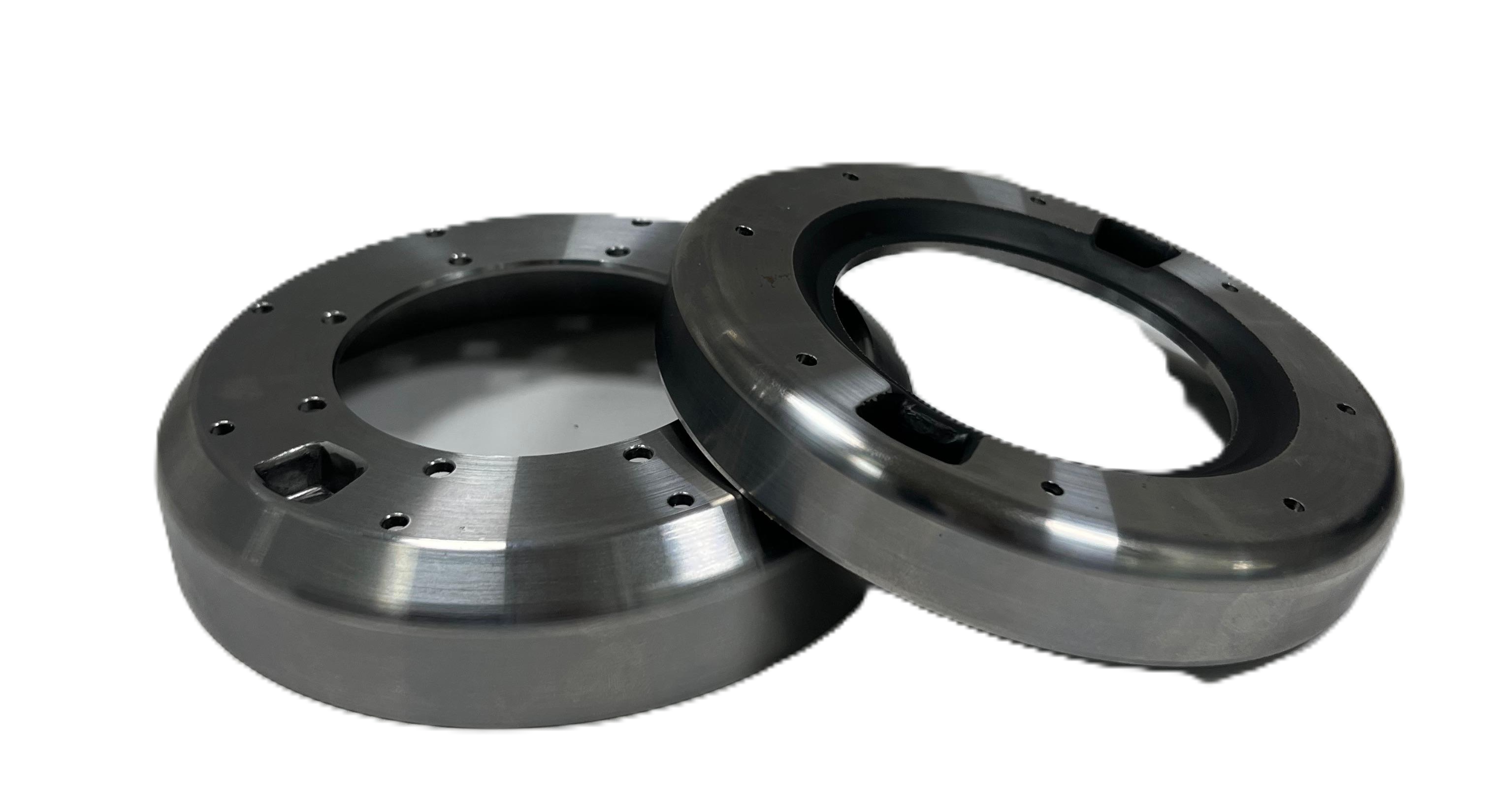
Radially Drawing Sheet Into a Formed Shell
Deep drawing radially draws a flat steel blank into a forming die using controlled punch pressure, producing a hollow, seamless shell in one or more draw stages — without the thinning or cracking risk of over-stretching the material. It's the process JBMK already relies on for our Damper Housing product line, where high roundness and concentricity are needed to support a bonded elastomeric element with balanced rotation.
We run deep drawing on the same 80–300T press capacity used for our stamping lines, with dies designed in-house and dimensional verification on CMM after each draw stage — not only on the finished part.
80–300 Ton Press Capacity
Multi-stage draw capability across a wide range of shell diameters and depths.
In-House Die Design
Draw-stage dies engineered in our own toolroom to control wall thinning and springback.
High Roundness & Concentricity
Held to ≤0.05mm on parts that need to support bonded or press-fit elements.
IATF 16949 Certified
Deep-drawn automotive parts produced under the same quality system as our pulley range.